




The National Women’s Law Center fights for gender justice—in the courts, in public policy, and in our society.
New Polling Shows Gender Equity and Basic Needs Programs Remain Popular While Trump’s Policies Are Not

New Polling Shows Gender Equity and Basic Needs Programs Remain Popular While Trump’s Policies Are Not
A full year into Trump’s second term, public support for Trump and his Project 2025-backed policies is rapidly evaporating. His public disapproval has hit new lows—including on issues that have been most favorable to Trump, like immigration and the economy. The National Women’s Law Center partnered with YouGov on a national survey of adults from January 9 to January 21, 2026, finding that the public strongly prefers economic justice policies that strengthen gender equity over the signature policies of the Trump administration, including key provisions from H.R. 1 (“One Big Beautiful Bill Act”).
What this survey tells us is that Americans are deeply concerned about the cost of living, and they believe guaranteeing and expanding basic needs programs and gender equity would do more for them and their families than Trump’s policy proposals would.
1. Economic concerns remain the top issue for Americans regardless of party affiliation
Consistent with other polling, respondents expressed deep concern about inflation, the state of the economy, their ability to afford health care, food and groceries, and their ability to raise a family. Respondents identified the need to bring down inflation and the cost of living as their top priority. Additionally, many of them felt that their situation was not only worse today than it was a year ago, but that things are not getting better. Many also blamed Donald Trump and his policies for their current economic outlook.
- 90% of respondents said they support passing policies that would bring down inflation and the cost of living. This includes 90% of Republicans, 92% of Democrats, and 75% of Independents;
- 70% of adults said they are worried about being able to afford health care, including 74% of Latinas, 73% of LGBTQ+ adults, and 82% of disabled women;
- 57% of adults believe it is harder to raise a child now compared to a year ago, including 61% of women overall, 68% of Latinas, and 64% of Black women;
- 68% of adults said they are worried about being able to afford groceries and food, including 71% of Latinas, 71% of Black women, 71% of LGBTQ+ adults, and 83% of disabled women.
2. Americans expressed desire for stronger basic needs programs and gender equity guarantees
The respondents we surveyed expressed a high degree of support for a host of policies that would expand access to basic needs programs and that advance gender equity, including affordable health care, contraception, protections against sex-based discrimination, and others. In other words, while the vast majority of people continue to express concern about the cost of living, they support economic and gender justice policies like the ones listed below.
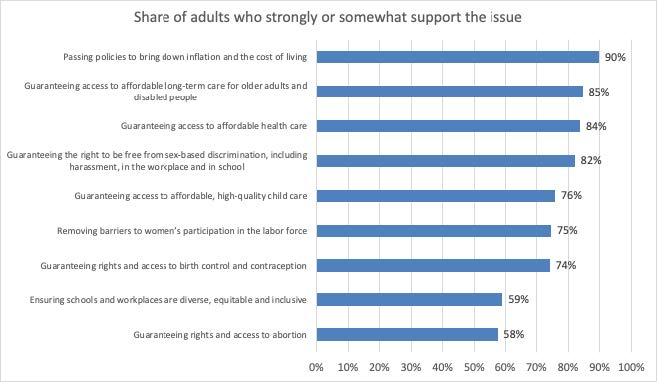
Just as importantly, support for these policies is consistently high among Democrats and Independents, while even Republicans expressed high support for many key policies and protections, including guaranteeing access to affordable health care, birth control and contraception, affordable long-term care for older and disabled people, affordable high-quality child care; removing barriers to women’s participation in the labor force; and protecting against sex-based discrimination at school and in the workplace.
| Share who strongly or somewhat support the issue | ||||
| All | Republican | Democrat | Independent | |
| Passing policies to bring down inflation and the cost of living | 90% | 90% | 92% | 75% |
| Guaranteeing access to affordable long-term care for older adults and disabled people | 85% | 79% | 92% | 72% |
| Guaranteeing access to affordable health care | 84% | 76% | 93% | 75% |
| Guaranteeing the right to be free from sex-based discrimination, including harassment, in the workplace and in school | 82% | 73% | 92% | 73% |
| Guaranteeing access to affordable, high-quality child care | 76% | 62% | 90% | 70% |
| Removing barriers to women’s participation in the labor force | 75% | 63% | 88% | 56% |
| Guaranteeing rights and access to birth control and contraception | 74% | 59% | 91% | 61% |
| Ensuring schools and workplaces are diverse, equitable and inclusive | 59% | 33% | 85% | 59% |
| Guaranteeing rights and access to abortion | 58% | 30% | 85% | 50% |
Respondents also said that a variety of gender justice policies would help them and their families:
- 80% of adults say policies that would help people afford health insurance would help them and their families, including 82% of women.
- 74% of adults say providing all workers with access to paid family and medical leave would help them and their families, including 81% of parents with children under 18.
- 62% of adults say strengthening protections against sex harassment at work and at school would help them and their families, including 68% of women.
- 61% of adults say strengthening protections against race and sex discrimination at work and at school would help them and their families.
- 74% of parents with children under 18 say policies that would make high quality child care affordable would help their family, as do 58% of adults overall.
- 71% of parents with children under 18 say increasing funding for public K-12 schools would help them and their families, as do 58% of adults overall.
- 57% of adults say protecting access to birth control would help them and their families, including 62% of women.
- 80% of parents with children under 18 say expanding the child tax credit would help them and their families, as do 55% of adults overall.
The responses above suggest that Americans feel pinched by the cost of living and inflation and believe that expanding basic needs programs, increasing access and funding for child care and K-12 education, and guaranteeing protections against sex-based discrimination would improve their economic situation.
3. Americans do not think that Trump’s policies will have a meaningful impact on their lives – and blame him and Republicans for failing to do more
Conversely, the respondents we surveyed did not believe that the signature policies of the Trump administration would have a meaningful impact on their lives. More adults oppose implementation of H.R. 1 (“One Big Beautiful Bill Act”) than support it (37% v. 35%, respectively). Importantly, when given more information about the provisions contained in the law, 52% of adults believe that H. R. 1 will make things worse for them and their family. The bill remains unpopular 7 months after passage, and the public does not believe it is a good solution for bringing down their cost of living.
We also asked respondents about some of the specific proposals being championed by the Trump administration and found that there was little support for them. Only 17% of adults said a national medal for having 6 or more children would help them and their family. Only 38% said that Trump Accounts for their children would be of help to them.
Across a variety of issues, when respondents expressed that the country was on the wrong track, they resoundingly blamed Donald Trump and Republicans in Congress for it.
- Cost of living: 62% believe the country is on the wrong track; of those, 82% blamed Trump and 58% blamed Republicans in Congress.
- Health care cost: 66% believe the country is on the wrong track; of those, 71% blamed Trump and 60% blamed Republicans in Congress.
- Health care access: 56% believe the country is on the wrong track; of those, 75% blamed Trump and 68% blamed Republicans in Congress.
- Access to abortion: 53% believe the country is on the wrong track; of those, 67% blamed Trump and 59% blamed Republicans in Congress.
- Diversity, equity, and inclusion (DEI): 51% believe the country is on the wrong track; of those, 71% blamed Trump and 56% blamed Republicans in Congress.
- Access to birth control and contraception: 45% believe the country is on the wrong track; of those, 72% blamed Trump and 67% blamed Republicans in Congress.
4. Americans want their elected representatives to do more to expand access to basic needs programs and to advance gender equity
Finally, survey respondents expressed a strong desire for their elected representatives to do more to bring prices down, expand access to key basic needs programs, and guarantee protections against sexual harassment and discrimination. For example, 70% of adults said Trump should be doing more to make sure they can afford everyday items they need, including 71% of women and 75% of mothers with children under 18.
When asked if their elected representatives should be doing more on a variety of economic and gender equity issues:
- 79% said they should be doing more to pass policies to bring down inflation and the cost of living;
- 71% said they should be doing more to guarantee access to long-term care;
- 60% said they should be doing more to guarantee access to affordable child care;
- 72% said they should be doing more to guarantee access to affordable health care;
- 52% said they should be doing more to protect against sex-based discrimination at work and at school.