Workers Deserve Better than Andrea Lucas
In 2020, a pregnant worker at a Walgreens pharmacy in Louisiana was working when she began spotting. Her doctor advised her to leave work and seek emergency care. But when she asked her manager to go, the manager denied her request, saying she had already asked for too many accommodations, according to the Equal Employment Opportunity Commission’s (EEOC) lawsuit.
Faced with the choice between the health of her pregnancy and her job, she was forced to quit.
Later that day, she miscarried.
When workers experience discrimination like this on the job, it undermines their equality, safety, dignity, and economic security. Our federal laws prohibit this discrimination and allow workers to seek damages for harms they experience, but where are workers supposed to turn to enforce those rights? That’s where the EEOC comes in.
What is the Equal Employment Opportunity Commission?
The EEOC is an independent, bipartisan federal agency that enforces federal civil rights laws for workers. The EEOC protects all workers from unlawful discrimination and harassment based on disability status, age, race, sex, sexual orientation, gender identity, and national origin. The EEOC helps people get, keep, and advance in their jobs free from discrimination, and it helps workers hold their employers accountable and obtain remedies when they do face discrimination.
In the case of the pregnant worker in Louisiana, the EEOC investigated her charge and ultimately sued Walgreens for violating Title VII of the Civil Rights Act and the Americans with Disabilities Act. The EEOC helped her recover financial damages from losing her job and ensured that Walgreens changed its policies to protect other pregnant workers from experiencing the discriminatory, dangerous working conditions she endured.
This is just one of many cases in which the EEOC helped deliver justice for employees and job applicants who were wrongfully discriminated against by their employers.
Since its inception during the civil rights movement, the EEOC has played a vital role in fighting discrimination in the workplace and advancing equity for workers across the United States. And over the past 60 years, the EEOC has been especially important in advancing women’s rights, particularly by going after employers who allow sexual harassment in their workplace, enforcing the rights of pregnant workers, and ensuring workers receive equal pay.
But now, the Trump administration is undermining the EEOC’s core mission and weaponizing it to attack hardworking people across the country. And Trump handpicked Andrea Lucas to lead the charge.
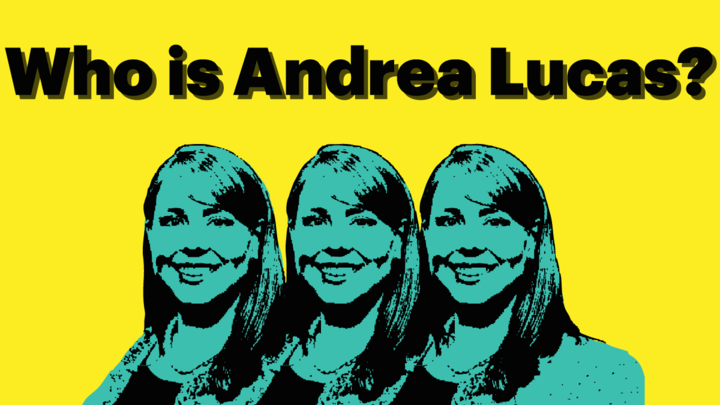
Trump first nominated Lucas to serve at the EEOC in 2020, and when he was re-elected in January, he elevated her to Acting Chair of the agency. As Acting Chair, Lucas made clear that she is simply a Trump loyalist dedicated to carrying out the administration’s radical agenda—including its crusade against DEI and its unrelenting attacks on trans people—at the expense of women, people of color, LGBTQIA+ folks, disabled persons, and really all workers. Despite her record, last week, the Senate voted to hand Lucas a second five-year term at the EEOC.
So let me introduce you to the recently confirmed Commissioner.
Andrea Lucas is a serious threat to workers – especially women, people of color, and LGBTQIA+ people.
As a worker, you deserve to work free from discrimination and harassment, and with that, you deserve the full force of the government’s enforcement agency behind you. But Andrea Lucas, at Trump’s direction, has made it harder for workers to enforce their rights and easier for employers to unlawfully discriminate. She’s particularly focused on attacking the LGBTQIA+ community, while masquerading her new policies as women’s rights.
Don’t fall for the Trump administration’s false advertising of Lucas as a champion of women – her efforts to “protect women” are nothing more than straight-up attacks on trans and non-binary workers (and basically attacks on any policies that make a workplace actually inclusive).
While the EEOC’s stated vision is “fair and inclusive workplaces with equal opportunities for all,” Lucas has twisted that vision and closed off opportunities for workers.
In Lucas’s short tenure as Acting Chair, she quickly targeted the rights of trans and nonbinary workers.
Immediately after being nominated, she directed the EEOC to drop several cases they were litigating specifically because the plaintiffs were trans or nonbinary—not because the cases lacked merit—abandoning these workers in the middle of their lawsuits.
To further solidify her erasure of trans and nonbinary folks, she eliminated the “X” option as a gender marker on the Commission’s discrimination charge intake form, creating another barrier for trans, nonbinary, and intersex folks to enforce the civil rights protections they are guaranteed under the law. She removed resources from the EEOC’s website that talk about protections for trans workers, and she made clear that if Republicans get a majority on the Commission, she will remove or revise formal Agency guidance on harassment in the workplace to fall in line with Trump’s anti-trans agenda.
Lucas is also using the EEOC as a weapon to attack diversity in the workplace. She’s released technical assistance to encourage workers to bring cases of so-called “DEI-related discrimination,” falsely claiming that practices that open doors to opportunity—such as trainings, educational programs, promotion of equitable pay, and broad recruiting practices might create a hostile work environment and violate the law (the logic is lacking, to say the least).
And she intends to make it harder to challenge discrimination by rolling back the Commission’s enforcement of disparate impact claims.
Disparate impact discrimination is when an employer enforces a policy that appears neutral but has a negative impact on a certain group of people. An example would be when a workplace has a policy that penalizes employees for absences regardless of the reason. This policy is likely to disproportionately harm women in the workplace because they often must take on more caregiving responsibilities at home.
The law prohibits disparate impact discrimination, but Lucas has vowed to stop enforcing this part of the law. Doing so will have far-reaching impacts, making it harder for people of color, disabled people, pregnant people, and often women, to make their case that they’ve been discriminated against.
When one group of workers is targeted, it harms them deeply, and the result is a weakening of protections for all workers.
Right now, while a significant portion of people, especially women, live paycheck-to-paycheck and lack stability at work, it’s critically important that the EEOC does its job to ensure everyone can have an equal opportunity to succeed at work. Instead, Lucas is more concerned with bowing to President Trump than fighting for workers’ rights.
And Lucas isn’t the only one President Trump wants at the EEOC. He’s also nominated Brittany Panuccio to serve as a commissioner – another person to serve as a rubber stamp for his extreme agenda. In a recent Senate hearing, Panuccio made clear she is ready to follow President Trump’s lead and let him dictate which workers the EEOC protects.
If Panuccio is also confirmed by the Senate, she and Lucas will have the power to reshape the EEOC and carry out President Trump’s agenda. But we won’t let them do that without a fight.
Last week, NWLC and Democracy Forward sued Lucas and the EEOC over the agency’s abandonment of transgender and nonbinary workers. We will continue to hold the EEOC accountable and fight for the rights of all workers to be free from discrimination in the workplace.