




The National Women’s Law Center fights for gender justice—in the courts, in public policy, and in our society.
Lower-Income Households Now Spend 95% of Their Pre-Tax Income on Basic Needs
Two Decades of Data Reveal that the Lower-Income Households Now Spend More of their Income on Basic Needs as Richer Households Spend Less
Washington, DC – Spending on basic needs has consumed an increasingly larger share of lower-income households’ income over the last two decades, while becoming less burdensome for the richest households, according to a new report released today by the National Women’s Law Center (NWLC). It comes as Congress and the Trump-Vance administration are making it increasingly difficult for women and families to afford essentials like food and health care.
Read the full report: Squeezing the Budget: Two Decades of Data Reveal Widening Disparities as Spending for Basic Needs Outpaces Income Growth for Lower-Income Households
“It is becoming increasingly harder for all but the highest income households to afford the basics,” said Sarah Javaid, senior research analyst and co-author of the report. “As the rich get richer, those at the bottom are seeing their wages stagnate while costs keep rising. Instead of righting this trend by making it easier for families to make ends meet, Congress and the White House chose to slash funding for programs that help people afford essentials, all in order to give even more tax breaks to households that need help the least.
“These types of policy decisions are why we’re seeing income inequality expanding. If lawmakers are serious about closing the income divide, then they need to focus on championing policies that help women and families afford the basics and invest in their future.”
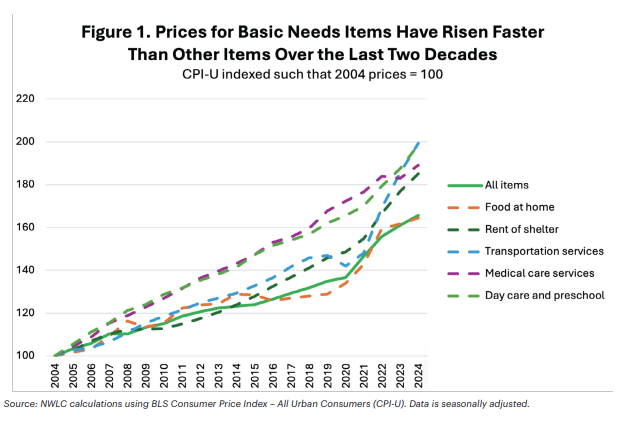
Drawing on two decades of spending and income data from the Bureau of Labor Statistics, the report examines household spending between 2004 and 2024 across five essential categories—housing, transportation, food, health care, and child care.
It finds that while households at every income level are spending more on these necessities than they did 20 years ago, lower-income households have seen this spending rise far faster than their income growth. By 2024, lower-income households were spending nearly all of their pre-tax income on basic needs alone, while higher-income households were spending a smaller share of their incomes on those same essential categories than they did two decades earlier.
Key Findings
- Lower-income households are falling further behind. Spending on essential goods increased 14.5%, while income grew just 5.5% between 2004 and 2024. As a result, lower-income households went from spending 87.5% of their pre-tax income on basic needs in 2004 to 95% in 2024.
- Higher-income households are getting richer. Spending on essential goods increased 6.7%, while income rose 18.2% since 2004. Their share of income devoted to basic needs fell from 40.2% in 2004 to 36.3% in 2024.
- Middle-income households saw little change. Spending on essential goods increased 9.9%, while income rose 9.1%, leaving the share of income spent on basic needs relatively stable over the past two decades.
- Housing drove the largest increase for lower-income households. Housing costs rose 21.9%, followed by transportation (19.5%) and groceries (15.6%).
The report includes policy solutions to help address this widening income disparity, including by boosting incomes for lower-income households, expanding basic needs programs, investing in public goods, and ensuring the wealthiest pay their fair share.
###